Praha -
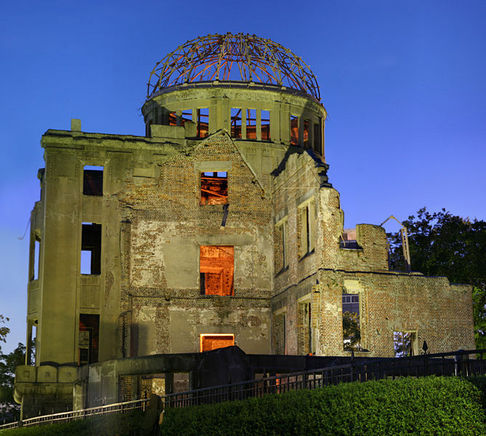
 Wednesday marked the world´s first nuclear attack. Vigils are held across the world to remember one of the biggest tragedies in the history of humankind but hardly any one remembers the creator of the only building that survived the Hiroshima atomic bomb attack.
His name was Jan Letzel and he came from Czechoslovakia.
On August 6, 1945 at 8,15 a.m. an American B-29 bomber Enola Gay dropped a bomb which demolished the city of 350,000. An estimated 70,000 died on the spot, while thousands lost their lives days and months later.
The bomb flattened the entire city centre, except the Hiroshima Industrial Promotion Hall, which was designed by Jan Letzel.
An apocalyptic photograph capturing the torso of the hall rising above the debris of the destroyed city shocked the whole world. The Industrial Hall, later dubbed A-bomb Dome, soon became one of the world´s most striking landmarks, a reminder of the war's atrocities.

Celebrated Concrete

The building miraculously survived the nuclear attack due to the construction material. All the other Hiroshima´s wooden and paper houses were entirely destroyed. nd it was probably concrete that made the young and talented architect well-known in Japan. This "European" construction material was earthquake-resistant, certainly more resistant than the traditional Japanese construction materials, wood and paper.

But without his talent and skills Letzel would have never made it. In Prague´s School of Applied Arts he was one of the best students and a favorite of Jan Kotěra, leading architect and interior designer of that period. Kotěra´s influence is evident in the only building that Jan Letzel built in then Czechoslovakia - Dvorana pavilion in Mšené Spa, 50 km north of Prague.
Mr. Cosmopolitan
Jan Letzel was born in 1880 in Náchod in north Bohemia in a family of a hotel owner. As soon as he finished his studies in Prague, he left Czechoslovakia for Cairo, Egypt. In 1907 he received an invitation from a German architect Georg De Lalande to come to Japan where he stayed for the next 13 years.
Letzel was in Japan all throughout World War One, despite the fact that Japan joined the Allied Powers - France, Britain and Russia - in 1914, which technically made the Austro-Hungarian architect an enemy, at least in the eyes of Japanese authorities.
He was able to steer clear of trouble, though, largely thanks to his acquaintances in high circles. Japanese author Murai Shimako, who wrote a play about Letzel, believes that good relations with local oligarchy were fundamental for his success in Japan.
Letzel was responsible for a total of fifteen new buildings in Japan. The only ones that survived until today are the Industrial Promotion Hall in Hiroshima and the gate of Tokyo's Catholic University of Sacred Heart. The former, now mostly known as A-Bomb Dome, has been on the UNESCO World Heritage list since 1996.
Instant Landmark
The massive building was completed in 1915. It instantly became a landmark in the city, as Murai Shimako confirms:
"Our teacher used to take us to the imperial sanctuary and the Industrial Palace was the only European building we would pass on our way. Back then, we thought the architect was Austrian. It wasn't until 1969 when I learnt that the palace had been built by a Czech architect."
Yet another Japanese woman, awed by the palace, found her way to Czechoslovakia at the time. Fumiko Fujita was also impressed by the building, but remained skeptical about Jan Letzel's alleged Austrian nationality. She knew that Jan was a Czech name.
With the help of Czechoslovakia's state broadcaster she was able to track down Letzel's nieces, who gave her access to the family's correspondence and various gifts which their uncle used to send them from Japan.
Citizenship corrected
Fujita then published a series of articles in Japanese magazines to correct the misinformed perception that Letzel was an Austrian. In spite of her efforts, the majority of Japanese people do not know a Czech architect named Retseru, as the Japanese pronounce his surname.
"Common Japanese naturally have no knowledge of Letzel but experts and architects do know him very well and respect him a lot," says Petr Holý, director of the Czech Centre in Tokyo.
Japanese journalist Yuki Masuda who moved to the Czech Republic not long ago regrets that Japanese kids do not learn about Letzel in schools. Letzel is widely believed to have introduced modern architecture to Japan, adds Masuda.
 Czech Out Yuki Masuda's Blog - http://blog.aktualne.centrum.cz/blogy/yuki-masuda.php
Jan Letzel returned to Czechoslovakia in 1923 and died alone and forgotten two years later. He lived his last days in the same room in Prague´s Institution for the mentally ill where Czech composer Bedřich Smetana passed away in 1884.
"His grave is empty, though, because he died of syphilis. The Christian-minded people of Náchod would never allow a person that died of a sexually transmitted disease to be buried in a consecrated land of Náchod´s cemetery," explains Petr Holý.

 Prague/Tbilisi- Czech Foreign Minister Karel Schwarzenberg, who has cut his holiday short over the conflict in Georgia, today said Prague supports Georgia where by a sad coincidence fights broke out shortly before the 40th anniversary of the Soviet-Russian led invasion of Czechoslovakia, by the "Warsw Pact" Troops in August, 1968.