Custom Search

Aktuálně.cz - czechnews

České Noviný

Czech Happenings

czech.cz

The Prague Tribune - the Czech business and lifestyle magazine

The Prague Post

Prague Daily Monitor - Czech news, business, arts and more

Radio Prague

Radio Prague - Subject Current affairs

Radio Prague - Subject Society

Radio Prague - Subject Foreign policy

Radio Prague - Subject European Union

Radio Prague - Subject History

Aktuálně

BBCCzech.com | Archive | Czech Archive index

Novinky.cz

Showing posts with label prague. Show all posts

14 August, 2008

Prague introduces chip card system similar to London's Oyster car


[14-08-2008 14:59 UTC] By Ruth Fraňková
ListenReal Audio 16kb/s ~ 32kb/s

The Prague Transport Authority recently launched a chip card system similar to London's Oyster card. The Opencard itself is not a novelty: Prague citizens have already been using it to pay their parking fees and take out library books. However, as of October, they can also use their Opencard as a public transport pass, charging it up with credit beforehand. I spoke to Michal Opatrný from the Prague Transport Authority to find out more about the new system:
“The aim of the project is to establish not only new ways of communication between the city and its citizens but also less complicated and more convenient access to the services provided by the city.”
What can the card be used for?
“First of all the Opencard serves as a replacement for vouchers and tickets to some of the city’s institutions and services. You can also use it in place of Prague public transport season ticket. Opencard is also accepted by certain branches of the Prague Municipal library. It can be used instead of coins when parking in paid zones. It is currently accepted by parking metres in the city centre and within the next few months this service will be extended to other zones as well. And you can use it for an easy and secure access to Prague’s website. For example drivers can use this application to obtain information about their current traffic offences including info about penalties and the number of points incurred.”
When did you actually start distributing the card?
“We have already started distributed over 6,000 old Opencards and about 70 new ones. During the autumn we would also like to launch nameless cards for tourists, who don’t need residence permits. They can simply buy the card and use it.”


Speaking about nameless cards, what kind of data do you actually need to provide a customer with the card?


“Prague citizens need to fill an application form. The Opencard will feature a photo of the applicant and his or her date of birth but no other personal details.
So in case I lose my Opencard you can provide me with a new one on the basis of the data that you already have.
“Yes, of course. If you lose your Opencard we give you a new one and provide you with a public transport ticket that you had previously bought.”

07 August, 2008

Fame Escapes Czech Who Gave Hiroshima Its Dome


Praha - Wednesday marked the world´s first nuclear attack. Vigils are held across the world to remember one of the biggest tragedies in the history of humankind but hardly any one remembers the creator of the only building that survived the Hiroshima atomic bomb attack.


His name was Jan Letzel and he came from Czechoslovakia.

On August 6, 1945 at 8,15 a.m. an American B-29 bomber Enola Gay dropped a bomb which demolished the city of 350,000. An estimated 70,000 died on the spot, while thousands lost their lives days and months later.


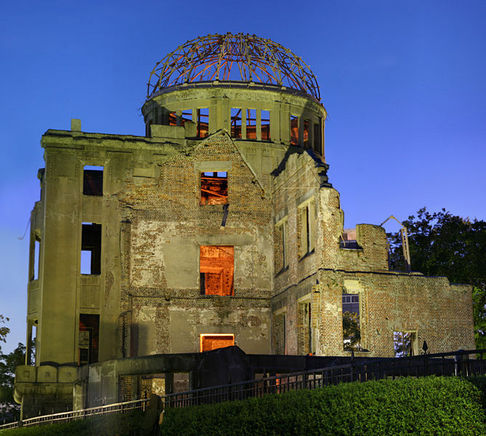
The bomb flattened the entire city centre, except the Hiroshima Industrial Promotion Hall, which was designed by Jan Letzel.

An apocalyptic photograph capturing the torso of the hall rising above the debris of the destroyed city shocked the whole world. The Industrial Hall, later dubbed A-bomb Dome, soon became one of the world´s most striking landmarks, a reminder of the war's atrocities.


Celebrated Concrete

The building miraculously survived the nuclear attack due to the construction material. All the other Hiroshima´s wooden and paper houses were entirely destroyed. nd it was probably concrete that made the young and talented architect well-known in Japan. This "European" construction material was earthquake-resistant, certainly more resistant than the traditional Japanese construction materials, wood and paper.


But without his talent and skills Letzel would have never made it. In Prague´s School of Applied Arts he was one of the best students and a favorite of Jan Kotěra, leading architect and interior designer of that period. Kotěra´s influence is evident in the only building that Jan Letzel built in then Czechoslovakia - Dvorana pavilion in Mšené Spa, 50 km north of Prague.

Mr. Cosmopolitan

Jan Letzel was born in 1880 in Náchod in north Bohemia in a family of a hotel owner. As soon as he finished his studies in Prague, he left Czechoslovakia for Cairo, Egypt. In 1907 he received an invitation from a German architect Georg De Lalande to come to Japan where he stayed for the next 13 years.

Letzel was in Japan all throughout World War One, despite the fact that Japan joined the Allied Powers - France, Britain and Russia - in 1914, which technically made the Austro-Hungarian architect an enemy, at least in the eyes of Japanese authorities.

He was able to steer clear of trouble, though, largely thanks to his acquaintances in high circles. Japanese author Murai Shimako, who wrote a play about Letzel, believes that good relations with local oligarchy were fundamental for his success in Japan.

Letzel was responsible for a total of fifteen new buildings in Japan. The only ones that survived until today are the Industrial Promotion Hall in Hiroshima and the gate of Tokyo's Catholic University of Sacred Heart. The former, now mostly known as A-Bomb Dome, has been on the UNESCO World Heritage list since 1996.

Instant Landmark

The massive building was completed in 1915. It instantly became a landmark in the city, as Murai Shimako confirms:

"Our teacher used to take us to the imperial sanctuary and the Industrial Palace was the only European building we would pass on our way. Back then, we thought the architect was Austrian. It wasn't until 1969 when I learnt that the palace had been built by a Czech architect."

Yet another Japanese woman, awed by the palace, found her way to Czechoslovakia at the time. Fumiko Fujita was also impressed by the building, but remained skeptical about Jan Letzel's alleged Austrian nationality. She knew that Jan was a Czech name.

With the help of Czechoslovakia's state broadcaster she was able to track down Letzel's nieces, who gave her access to the family's correspondence and various gifts which their uncle used to send them from Japan.

Citizenship corrected

Fujita then published a series of articles in Japanese magazines to correct the misinformed perception that Letzel was an Austrian. In spite of her efforts, the majority of Japanese people do not know a Czech architect named Retseru, as the Japanese pronounce his surname.

"Common Japanese naturally have no knowledge of Letzel but experts and architects do know him very well and respect him a lot," says Petr Holý, director of the Czech Centre in Tokyo.

Japanese journalist Yuki Masuda who moved to the Czech Republic not long ago regrets that Japanese kids do not learn about Letzel in schools. Letzel is widely believed to have introduced modern architecture to Japan, adds Masuda.

Czech Out Yuki Masuda's Blog - http://blog.aktualne.centrum.cz/blogy/yuki-masuda.php

Jan Letzel returned to Czechoslovakia in 1923 and died alone and forgotten two years later. He lived his last days in the same room in Prague´s Institution for the mentally ill where Czech composer Bedřich Smetana passed away in 1884.

"His grave is empty, though, because he died of syphilis. The Christian-minded people of Náchod would never allow a person that died of a sexually transmitted disease to be buried in a consecrated land of Náchod´s cemetery," explains Petr Holý.


25 June, 2008

LN: Roma to set up vigilante patrols in Karlovy Vary


Prague, June 24 (CTK) - Romanies in Karlovy Vary, West Bohemia, will set up their own patrols outside a local school in response to the patrols established by the Czech extremist National Guard (NG), Lidove noviny (LN) wrote Tuesday.

NG's patrols are to start guarding the school against what they call attacks by local Romany children against the schoolchildren later Tuesday.

The Romany children are from a hostel inhabited mostly by Romanies.

Last week, NG members went to the hostel "to explain their position" to the Romanies.

"We do not need any patrols here," a local Romany told the paper.

Stanislav Sivak, an activist of the local Romany Civic Association, said a brawl that occurred a few weeks ago had been investigated by the police.

"This is certainly no Romany gang that would harass the area," Sivak said.

"The authorities have enough measures with which to punish the parents who do not look after their children. Maybe they should be stripped of some welfare benefits," Sivak said.

Sivak said since Romanies feared for their children, too, they wanted to protect them outside the school.

At present, the school is being watched by police patrols.

Representatives of the National Party (NS), that had set up the para-military NG, are of the view that the problem was caused by the Romany children from the hostel for rent-defaulters.

"We will settle the repeated attacks on schoolchildren," Pavel Sedlacek from the NS press office told CTK.

NG members also want to organise a free self-defence course for local children.

There is tension among parents of the local schoolchildren, LN writes.

"If anyone harms my child, I will be very tough. I have a pistol and I would not hesitate to use it," LN quotes a father as having said.

Three children from the fourth grade told the paper they had been victims of a recent attack by Romany children.

"It happened about three weeks ago. We were suddenly attacked by the Gypsies," a boy, aged 10, said.

"One of them had a knife and asked us whether we want our hands to be cut off. Another one hit a friend of mine in his head. We took to our heels," he added.

The assailants were six to seven years old.

"They were younger, but it was unpleasant. Now both of us are trained for the fight with a stick," another boy said.

22 May, 2008

EU presidency - Czechs are not too thrilled

In January 2009, the Czech Republic will begin its six-month presidency of the European Union. However, according to a poll conducted by the Public Opinion Research Center (CVVM) it appears that as much as three quarters of Czech citizens are not interested in this momentous event at all. Only 24 percent responded that they are interested in the Czech presidency of the EU. This group is composed predominantly of university-educated people and potential voters of the right-wing Civic Democratic Party (ODS).

According to the CVVM, the public's awareness of the issue is even worse. No more than one fifth of the society have sufficient information about what the EU presidency means, how the government is preparing for it and who is participating in the process.

However, the question whether those polled believe that the Czech Republic will be successful in its role brought more positive responses. Half of those questioned expect the Czech Republic to succeed.

The CVVM conducted the poll this year in the first half of April, questioning more than one thousand people.

For more detailed information czech out: Czech Presidency of the Council of the European Union

18 April, 2008

US Radar Plans In Action


The negotiations about the planned US radar base in the Czech Republic has taken a new course as Prague declared its wish to have the Czech army modernized by the Americans.
Concretely, the Czech Republic would like to be assisted by the USA in its planned acquisition of military transport planes and modernization of anti-aircraft defense, informed Czech Television (ČT), a public service broadcaster. So far, the government has been speaking only of scientific and economic cooperation with the USA. "We have asked the USA for cooperation in acquisition of tactical transport aircrafts and we would like to discuss this issue together with radar base negotiations," said the Deputy Minister of Defense Martin Barták. According to the ČT, the Czech Army plans to get two Hercules transport planes that would replace small and obsolete Antonov aircrafts still used for transporting Czech soldiers to foreign missions.

Karel Kryl, Svoboda a Demokracie, Nezakladnam ! NE !